
★ A New Realm Awaits
“In a world forged by war, only the relentless endure.”
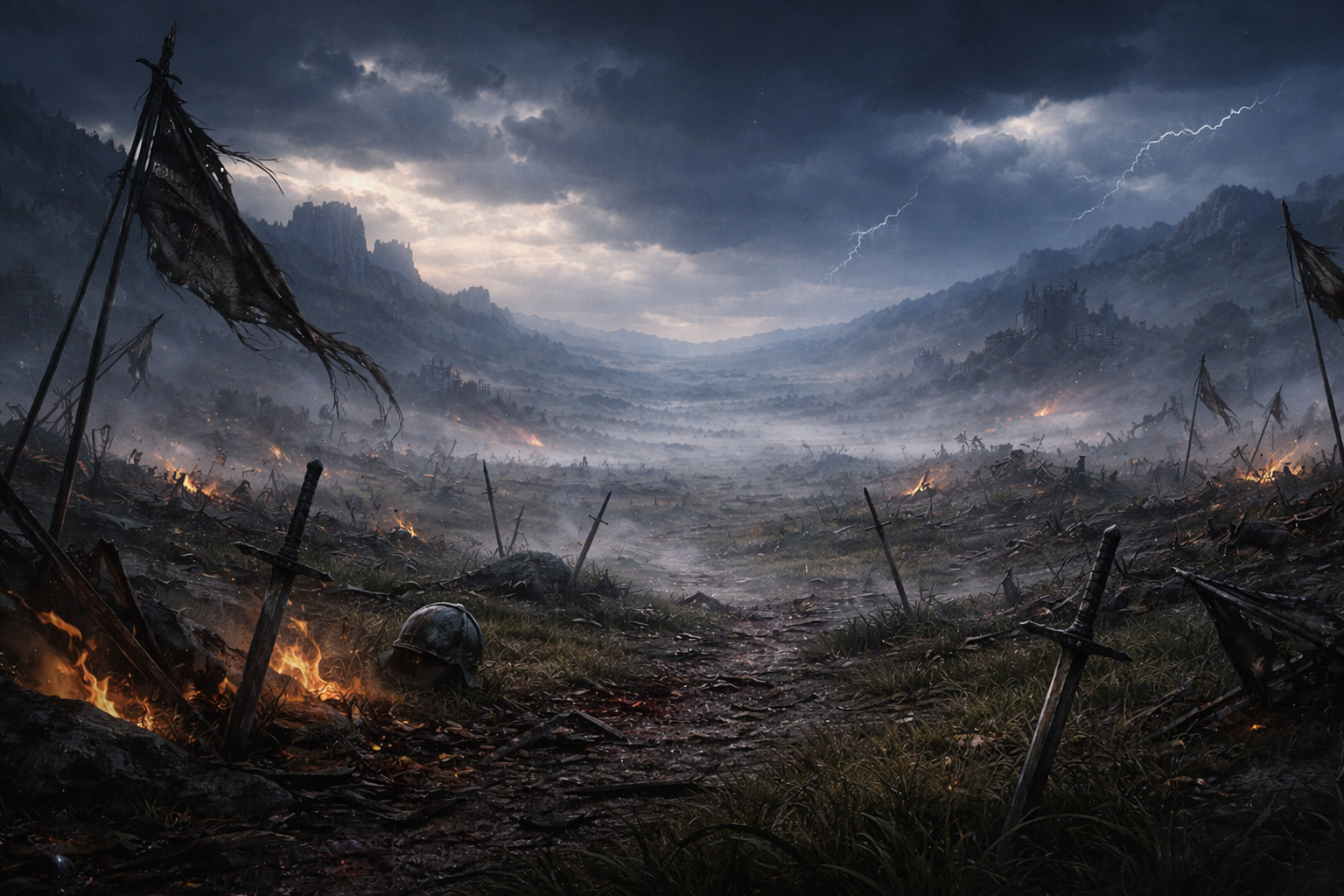
In the Realm of Zyltharn, peace is nothing more than a fading myth, drowned beneath the chaos of the Endless Sword War. Nine factions battle relentlessly for control, their banners rising over burning plains, shattered kingdoms, cursed forests, frozen seas, and ruined cities. Welcome to the Realm of Zyltharn — where nine factions wage endless war.
Lore
Uncover the history of the Realm of Zyltharn.
-
The Endless Sword War is not remembered as a single conflict, but as a perpetual state of existence that came to define the Realm of Zyltharn itself. No one knows how it started but it’s a cycle of conquest, retaliation, and survival. No generation has lived without it, and no power has risen untouched by its influence. Battlefields shift like seasons — burning plains, shattered kingdoms, cursed forests, frozen seas, and ruined cities all serve as stages for endless struggle. Alliances form and collapse with ruthless frequency, victories fade into new conflicts, and even moments of peace are merely pauses before inevitable violence. The war reshaped everything: races evolved, factions hardened, and dragons became instruments of dominance.
The Endless Sword War did more than reshape battlefields — it redefined society itself.
As conflict became the foundation of existence, wealth and survival grew inseparable from war. The elite and noble classes, far from remaining distant observers, became some of the war’s most active participants. Nobles command armies, lead campaigns, and carve their legacies directly into the battlefield. Power, prestige, and lineage are proven through conquest as much as influence. They finance factions, supply conflicts, and engage in the violence they help sustain. Within these circles, even slavery became deeply ingrained — a symbol of currency, status, and control in a world where power is everything.
For the middle class, stability is a fragile illusion. Professions vanish as quickly as cities, and survival often depends on faction service. Many join not from loyalty, but necessity, becoming soldiers, strategists, craftsmen, and specialists feeding the endless demands of war.
For the poor, existence itself is transactional. With protection scarce and opportunity nearly nonexistent, desperation drives banditry, murder and in the darkest reaches of Zyltharn, even their very own flesh and blood become currency. However joining a faction is often not allegiance, but the cost of survival — a meal, temporary safety, or the chance to endure another day
-
The Endless Sword War did not begin with armies, but with division.
After the Great Divide, when Vampires, Werewolves, Humans, and Elves fractured into separate powers, the Ebony Empire was formed to unite the races, emerging as the oldest and most dominant faction. Forged from ambition and the desire for absolute order, Ebony rose from the chaos of racial conflict, establishing itself as the first true empire of Zyltharn under the Hozollern royal bloodline.
From resentment and shadowed fury came the Nightingales, born from an ancient grudge against the Ebony Empire. What began as resistance evolved into a secretive order of assassins, spies, and unseen manipulators who wage war through silence rather than conquest.
The Guild of Animals arose from a different cause entirely — the need for sanctuary. Rejecting the destruction brought by expanding civilizations, they sought to preserve the primal world, creating a faction devoted to instinct, nature, and the protection of beasts.
The Pryzar Faction traces its origins to the Great Dragon Pryzar, whose influence shaped warriors and conquerors alike. Pryzar’s legacy birthed a power defined by discipline, expansion, and dominance.
The Kizar Army itself formed later, when wandering barbarians reached the coasts and encountered Vikings and Amazons. From this collision of cultures came a hardened military force built on survival, adaptability, and coastal supremacy.
The Lost Lords were born from desperation and vanity — a gathering of nobles who sought immortality rather than extinction. Through forbidden means and dark bargains, they abandoned mortality and became something far more dangerous.
Far from politics and conquest, the College of Marisa began as an idealistic vision. A circle of mages, weary of endless conflict, carved out a place to pursue knowledge, experimentation, and arcane mastery in peace — though peace would never truly last.
The Order of Saint Christine emerged through faith, founded by a heroic paladin who believed Zyltharn required divine guidance. What began as devotion became doctrine, and doctrine became power.
Last to rise, yet relentless in spirit, were the Freedom Fighters — a faction forged from ex-slaves, criminals, and war victims. Bound not by heritage but by survival, they became a sanctuary for the broken and a rebellion against oppression itself.
Together, these factions did not simply inherit war.
They became its cause.
-
Zyltharn is not a world where races remained static.
It is a world where survival forced evolution.
Humans
Humans, once considered the most vulnerable race, adapted across generations of conflict. Through relentless warfare, exposure, and innovation, humanity learned to withstand the supernatural advantages of vampires and werewolves. No longer fragile, humans now fight on near equal ground, their resilience, tactics, and adaptability becoming their greatest weapons.
Elves
Elves, traditionally masters of magic and arcane refinement, were reshaped by the brutality of endless war. Forced beyond their classical identity, many elves developed formidable physical prowess, hybrid combat disciplines, and survival-driven abilities. Elegance gave way to necessity. Perfection became versatility.
Vampires
Vampires underwent one of the most controversial transformations in Zyltharn’s history. Through centuries of selective breeding and forbidden experimentation, many evolved beyond traditional weaknesses. Sunlight no longer ensures their destruction, and the ancient dependence on blood has diminished or vanished entirely. As a result, vampires are no longer universally classified as undead, but as a living race shaped by predatory lineage and dark innovation.
Werewolves
Werewolves similarly defied their origins. Generational refinement and experimentation granted them controlled transformation, allowing shifts at will, independent of lunar cycles. Many now move freely in their lycan forms, their presence normalized within cities and factions alike. Yet during full moons, emotional intensity surges, and the beast within strains against restraint. Only the most disciplined retain absolute control, while the inexperienced are often confined for their own safety — guarded, not imprisoned.
Dragons
Dragons are the oldest and most dominant beings in Zyltharn, Though born superior, the Endless Sword War reshaped their role, turning dragons into the backbone of factional power. Coveted for their immense strength and devastating abilities, many are claimed, enslaved, or adopted by nobles seeking dominance. As a result, countless dragons live in secrecy, hiding among mortals. In their daily lives, they often assume human forms, moving unnoticed within society — but when conflict calls, they shed their disguise and transform into their true apex forms.
Half-Breeds
Half-breeds are beings born with two or more racial lineages, carrying the combined inheritance of Zyltharn’s dominant races. Unlike simple hybrids, half-breeds are defined by layered ancestry — bloodlines shaped across generations of interbreeding, war, alliances, and survival.
In a world where races have lived, fought, and evolved alongside one another for centuries, bloodlines inevitably intertwined. Half-breeds may possess traits drawn from multiple racial origins — physical adaptations, instinctual tendencies, arcane affinities, or subtle physiological advantages.
Some half-breeds exhibit dominant racial characteristics, while others manifest complex blends that defy traditional classification. Strength, abilities, and even biological stability vary dramatically, making each half-breed uniquely unpredictable.
-
Api — God of Fate
Api is the divine author of existence, the unseen writer of mortal stories. It is said that every life, triumph, tragedy, and downfall begins within his endless script. Yet Api is not bound by permanence — he rewrites, alters, and reshapes the paths of those touched by his will. Champions devoted to Api often display impossible fortune, sudden reversals of destiny, or reality-defying survival. He is eternally linked to Jukem, for fate and destiny are inseparable forces.
Jukem — God of Destiny
The string god watches the infinite strands of destiny that bind all beings. Where Api writes, Jukem weaves. He observes the threads of possibility, severing some, creating others, and entangling countless lives in unforeseen outcomes. Destiny, unlike fate, is fluid — and Jukem thrives within that fluidity. His followers believe no future is fixed, only guided. His divine connection to Api forms one of the most powerful cosmic dualities in Zyltharn.
Saint Christine — The True Paladin
Saint Christine stands as the embodiment of divine justice, faith, and unyielding righteousness. Once a mortal paladin of unmatched virtue, Christine ascended beyond mortality, becoming Heaven’s Eternal Warrior. Her presence is invoked in moments of courage, sacrifice, and holy judgment. Paladins, zealots, and crusaders revere her as both protector and executioner.
Marisa — Goddess of Magic and Cosmos
Marisa governs the infinite expanse of magic, stars, and cosmic forces. She represents curiosity, arcane mastery, and the boundless mysteries of existence. To her followers, magic is not a tool — it is the fundamental language of reality itself. The College of Marisa stands as a living extension of her divine influence.
Drakem — God of Oblivion
Drakem is the silent erasure, the inevitable collapse of all things. He governs decay, oblivion, and the dissolution of existence itself. His followers, marked by blue attire and spectral butterfly companions, embrace loss, destruction, and the beauty of endings. Drakem does not destroy with fury — he unravels with certainty.
Kimdargi — Goddess of Animals and Nature
Depicted as a divine jaguar, Kimdargi embodies instinct, survival, and primal balance. She governs beasts, wilderness, and the untamed forces of nature. Her followers reject artificial order, believing strength lies within natural law. Predators, hunters, and shapeshifters often invoke her blessing.
Nacromoss — God of Devouring and Consuming
Feared and worshiped in secrecy, Nacromoss represents hunger without limit. He governs consumption, corruption, and the relentless urge to take, absorb, and dominate. His influence is often associated with monstrous transformations, cursed relics, and forbidden rituals.
Balor — God of Love and Heartbreak
Balor governs passion, obsession, longing, and emotional ruin. He is beloved in Mal, the wild coastal city of indulgence and chaos. Devotion to Balor is as dangerous as it is intoxicating, for love and suffering are inseparable within his domain.
Glaz & Gulden — Twin Gods of Fortune
The divine twins rule over luck, deception, and opportunistic fate. Worshiped by thieves, gamblers, twins, and tricksters, they embody unpredictability and duality. Their blessings are rarely stable — fortune always demands balance.
The Black-Eyed God — The Lost Dragon of Twisted Fate
Once a god of unimaginable power, the Black-Eyed God threatened the foundations of fate and destiny themselves. Capable of unraveling reality’s guiding forces, he was sealed by the united will of the pantheon. His name is whispered only in forbidden texts and apocalyptic prophecy.
Crashdorgan — The Blood-Savage God
Crashdorgan is brutality, frenzy, and feral corruption incarnate. Unlike distant gods, he actively engages with mortals, driving them into madness, savagery, and monstrous transformation. He is both feared and wildly revered — the most popular of the dark gods.
Ravidorn — God of the Grim and Undead
Ravidorn governs death’s persistence — the undead, the recycled soul, the refusal of final rest. Worshiped heavily by the Lost Lords, he oversees the endless return of spirits to the realm.
Wildor — God of Mountains and Strength
Wildor embodies endurance, resilience, and raw physical supremacy. It is said he produces powerful offspring, leaving them scattered across the wilderness as living vessels of his strength.
Vorthalax — Dragon God of Power
Vortbalax represents dominance, draconic supremacy, and transcendence through power. His teachings birthed the True Lineage Cult, whose followers revere dragons not as beasts, but as divine evolution.
Nerithys — Siren Goddess of Sorrow
Nerithys governs grief, despair, longing, and emotional drowning. Worshiped by widows and the broken-hearted, her influence is as tragic as it is seductive.
Arealon — God of Wind and Endless Skies
Arealon is freedom, movement, and boundless possibility. Travelers, wanderers, and free spirits invoke his blessing.
Morvethis — God of Pestilence and Insects
Morvethis governs decay, disease, and swarming inevitability. His followers often receive living insect companions as divine guardians.
Sanguivar — God of Vampires
The patron deity of vampiric existence, Sanguivar governs bloodlines, hunger, immortality, and aristocratic predation.
Lunovar — God of Werewolves
Born from lunar force and instinctual dominance, Lunovar governs the savage duality within all lycan beings — the eternal conflict between restraint and fury, mind and instinct, control and release. The moon itself is said to be an extension of his will, its cycles dictating the rise of hunger, rage, and metamorphosis.
Sylvaelis — Elven Goddess of Grace and Memory
Sylvaelis governs elegance, memory, and the living forest. Her worship is deeply tied to elven identity, tradition, and superiority doctrine.
Valmara — The Dark Goddess
Valmara is an enigma. Forgotten, vanished, or perhaps concealed, she remains one of Zyltharn’s greatest divine mysteries. Only a handful of followers still invoke her name.
-
Relics are legendary artifacts crafted by the Goddess Marisa, manifestations of arcane power that have shaped the course of Zyltharn’s history. Across generations, they have been wielded to win battles, overturn wars, and elevate champions beyond mortal limits. Yet despite the College of Marisa’s relentless study of magic, even its greatest mages remain uncertain how Marisa forged these objects of impossible design. Each relic is unique, its abilities varying beyond predictable structure, contributing to what scholars describe as an endless cycle of creation. Countless relics have emerged throughout history, while many remain unrecorded, lost to time, secrecy, or destruction.
-
Enchantments are small, mysterious stones scattered throughout the Realm of Zyltharn, fragments of concentrated energy that bind themselves to those who claim them. Unlike relics, enchantments are far more common, yet no less transformative. When an individual takes hold of an enchantment stone, its power fuses instantly and permanently with their body, abilities, and even their weaponry. A warrior who claims a fire enchantment may find their strikes ignited with flame, their blade burning with elemental force. The bond, however, is irreversible — once infused, an enchantment cannot be exchanged, removed, or altered.
Through extensive study, scholars have concluded that enchantment stones naturally form when raw, unstable magic saturates an area, condensing over time into tangible vessels of power. Yet this process is not entirely beyond mortal reach. Rare individuals have attempted to artificially create enchantments by manipulating raw magic directly — a practice regarded as extraordinarily dangerous. Raw magic is volatile, unforgiving, and resistant to control; even the slightest miscalculation can result in catastrophic backlash, often leading to severe corruption, loss of control, or immediate death.
Recorded Stones:
Dark
Charm
Blighted
Savage
Dragon-Touched
Arcane
War-Master
Silent
Beast
Insect Swarm Infused
Golden Tongue
Spiritualist
Bloodhound
Occultist
Holy
Poison
Mirror
Explosive
Storm child
Eclipse
Full Moon
Fire
Ice
Earth
Wind
Oblivion
Song/Music
Flower
Explore the Realm

FACTIONS
Align yourself with powerful factions, build alliances, and shape your destiny in a world divided by loyalty, ambition, and honor.

Regions
Explore vast continents, hidden realms, and the shifting borders of power.

CLASSES
Choose your destiny

CAPITAL & TOWNS
Discover ancient civilizations

CREATURES & ENEMIES
Face the darkness within
Book 1 Now Available
Legacy of Hue
Follow his journey from prince to freedom fighters Ambassador in this epic tale of freedom, sacrifice, and the unbreakable spirit on Wattpad and Webtoons.